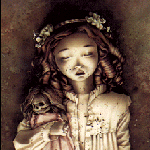
Hidden Portrait
Mariel Hewitt had been walking around the Riverfront Mall for close to five hours, searching for appropriate Christmas presents for her friends and relatives. She had hoped she would finish her shopping early and not have to venture into the mall during the final few weeks before the holiday, a time when the stores were at their busiest and people's tempers at their shortest.
Once again, however, she was faced with her annual dilemma: what to buy for her cousin Andy. Andy was Father Andrew McDowell, and Mariel had a hard time selecting a gift suitable for a priest. He enjoyed art, so the previous Christmas she bought him a set of books on the lives of famous painters. Two years earlier, it was a pewter reproduction of Rodin's Hand of God. Perhaps this year she would give him an oil painting, one that he could hang in his room in the rectory.
Mariel headed toward Suitable for Framing, an art gallery that dealt in inexpensive prints and posters. After perusing the artwork on display, she was disappointed to see nothing but the usual city skylines, bowls of fruit, lighthouses, beaches, nudes, autumn foliage and various forms of wildlife.
"Excuse me," she called to the sales clerk. "I'm looking for a gift to give to a priest. Do you have any paintings with a religious theme? Perhaps something by Raphael or Michelangelo?"
"I'm afraid not," the man answered. "I suggest you see what's available online. You might want to try Amazon or eBay."
"I never thought about that. Thanks for the idea."
Several times during the following week, Mariel searched through listings on eBay, but most of the items up for auction were already priced way out of her budget. Just when she was about to change her mind and buy Andy either a wool sweater or a terrycloth bathrobe, she found the perfect gift. She was not familiar with the artist's name, but what did that matter? The painting was beautiful! It was a warm and inspiring depiction of an angel carrying a little girl in one strong, protective arm and a tiny infant in the other.
In his description of the item, the seller claimed to have found the painting in the attic of an old farmhouse. He described its general condition as "good, but needs some cleaning." The opening bid was very low, but there were still three days before the auction ended. No doubt the final price would be much higher.
Feeling she had nothing to lose, Mariel typed in her maximum bid and hoped for the best. Three days later, she received a notification from eBay that she had been the high bidder. She quickly emailed the seller to arrange for payment and shipping.
By the end of the week, Mariel received the package from UPS. When she opened the box to examine the painting, she was a bit disappointed to see that it needed more than a light cleaning. It was obviously a job for a professional, not something she could take care of with a damp cloth or a dust rag. The next day, Mariel took the painting to a local art supply store for an estimate.
"How bad is it?" she asked Max Denton, the owner of the shop, once he had a chance to examine it.
"Not too bad. Most of it is surface dirt. I can probably have it ready by the middle of next month."
"Next month? But I planned on giving it as a Christmas present."
Mr. Denton frowned and shook his head.
"I wish I could help you out, but in addition to running this store, I paint portraits on commission, and like everyone else, Christmas is my busiest time of the year."
"Of course. I understand."
"You know, it's not that difficult to clean a painting if you have the proper chemicals. I could sell you what you'd need, and you can do the job yourself."
* * *
Mariel covered her kitchen table with old newspapers and then placed the canvas on it. She read Mr. Denton's directions while putting on a pair of latex gloves.
"Well, here goes nothing," she muttered in a voice void of confidence.
First, she used a paint neutralizer to eliminate the dust and surface dirt from the painting. Next, she had to remove the old, yellowed varnish that was meant to protect the artist's work. She dipped a cotton swab into the varnish remover and applied it in a gentle, rolling motion. It was a slow, tedious procedure because she had to clean one small patch at a time and then quickly apply the neutralizer to stop the cleaning process before it removed the paint itself.
Mariel had been hard at work for hours when the phone rang. She went to answer it, forgetting to apply the neutralizer to the area she had just cleaned with the varnish remover. When she came back into the kitchen, she saw that some of the paint had already dissolved. Now, a patch of black marred the light blue of the sky.
I've ruined it! she thought with despair.
Trusting in Max Denton's holiday spirit, she took the canvas back to the art supply store the following morning.
"Please tell me there's something you can do to save this painting!" she cried.
Taking pity on her, the owner said he could try to match the paint and repair the damage.
As Denton mixed his white and blue paints, he told Mariel, "I see you've got another painting under this one."
"What?"
"The black paint underneath the blue is from an earlier painting. It's not an uncommon thing. Sometimes the picture underneath is a 'rough draft.' But from what I can see from this small patch, I'd say it was of an entirely different subject."
"Why would someone paint over another picture?" she wondered.
"Because it was often cheaper to paint over a discarded canvas than it was to buy a new one. Did you know that there have been cases where people have discovered masterpieces beneath more mediocre works?"
"You mean there could be a valuable painting underneath this one?"
"It has happened. Naturally, most people won't destroy a newer painting unless they have a pretty good idea of what's beneath it."
Denton carefully applied the blue paint to the black patch.
"That looks pretty good," he announced after he had finished. "Once it dries, I doubt you'll be able to tell the difference."
* * *
Mariel took the painting home and, being careful to avoid Mr. Denton's repair work, continued the cleaning process. After the entire surface of the painting was free of dirt, the last step was to apply a fresh coat of clear varnish. When she opened the can, the fumes were overpowering, and she quickly put the lid back on.
I'll have to finish this tomorrow, she decided. And I'll be sure to work near an open window.
To avoid any unforeseen accidents, Mariel moved the canvas to her bedroom and set it on top of her dresser. As she prepared for bed, she stared at the painting of the angel, wondering what could be underneath it. She was tired, and her eyes must have been playing tricks on her because for a moment she thought she saw a face peering back at her.
The next day, Mariel placed the kitchen table beneath the window, which she opened wide despite the near-freezing temperature outside. Then she took out a slot screwdriver and tried to pry the lid off the can of varnish. It would not budge. She took a cotton swab and wiped a small amount of neutralizer along the edge of the lid, hoping to dissolve any hardened varnish, but no matter what she tried, she could not get the lid off.
I'll stop at the art store on the way home from work tomorrow and buy another can.
Carrying the painting back to her bedroom, she thought she heard a child's voice. Perhaps Henrietta Lawton, the old woman who lived downstairs, had a grandchild over for the day.
Mariel put the canvas back on her dresser. Were her eyes playing tricks on her again? No. There was a face on the canvas! One image was superimposed over another, like a double exposure on a photograph.
It must be the painting beneath that of the angel.
When Mariel woke the next morning, the first thing she saw was the painting on her dresser. With the sunlight shining brightly on it, the outline of the face was even more pronounced. Yet she could not distinguish the features because of the paint that had been applied over the original portrait.
I certainly can't give this painting to Andy as it is, she sighed.
Mariel picked up her JCPenney catalog and ordered a backgammon set for her cousin instead. While that solved her Christmas shopping predicament, she was still left with the problem of what to do with the painting. She doubted she could resell it on eBay.
Who would want to buy it in its present condition?
Ultimately, she decided she would show it to Andy and explain the situation. If he wanted it, he could have it. If not, she would throw it out.
Late that night, she was awakened by the sounds of a child calling for help. Muriel knew that Henrietta was old and not in the best of health, so she was concerned about the little girl's safety. She put on her robe, went downstairs and knocked on the old woman's door. After several minutes, Mrs. Lawton answered.
"Mariel, what's wrong? It's the middle of the night, dear."
"I heard a little girl crying for help. I assumed it was your granddaughter, and I was afraid that she or you might be hurt."
"I don't have any grandchildren. I'm all alone here."
"Oh, forgive me, Mrs. Lawton. I thought the cries were coming from your apartment, but they must have been coming from outside."
Feeling like a fool, she again apologized to her elderly neighbor for the late-night disturbance and returned to her own rooms, where once again she heard a little girl calling for help. This time, the sound seemed to be coming from the painting!
Mariel took the canvas out to the kitchen, laid it on the table, opened the new can of varnish remover and began to apply the solvent to the newer layers of paint. As more of the original painting was revealed, she became mesmerized by the child in the portrait. The girl was no more than ten years old, with dark hair and large, dark eyes that stared vacantly out of the painting like those of a lost waif.
She looks like such a sad little girl, Mariel mused.
From the moment the child's image was uncovered, strange things began happening around her apartment. The lights went on and off by themselves. Items fell off shelves or out of closets for no apparent reason, yet Mariel—not a believer in the supernatural—did not connect those odd occurrences with the newly revealed portrait.
* * *
While Mariel was waiting in line at the bank on Monday morning, she felt someone tap her on the shoulder. She turned and saw Max Denton, the owner of the art supply store, standing behind her.
"I thought it was you," he said with a friendly smile. "How did everything go with that painting? I hope you didn't have any more trouble cleaning it."
Mariel told him about uncovering the portrait beneath.
"I'd like to see it sometime if I may."
On Saturday, Mariel brought the painting to the art store.
"I don't suppose it's some long-lost masterpiece," she laughed.
"It's very interesting," he replied and looked for the artist's signature in the lower-right-hand corner. "Francis Pruitt? Why does that name sound familiar?"
He walked over to a set of hardcover books on famous artists.
"Here it is," he said after thumbing through the pages. "Francis Pruitt was a nineteenth-century painter from Boston. It says here that early in his career, Pruitt painted many portraits, and then in 1842, he had some sort of mental breakdown, after which he only painted pictures with a religious theme."
"This must be one of his early works. I wonder if it's worth any money."
Denton quickly scanned the remainder of the article.
"I'm afraid Pruitt's early portraits aren't in much demand."
Mariel looked disappointed.
"He had to support himself with his painting, so his early works were strictly private commissions, mainly family portraits and an occasional oilogram."
"What's an oilogram?"
"A postmortem portrait. Years ago, it was common for a family to want a remembrance of a loved one who had died, so they would hire an artist to paint a portrait of the corpse."
"You don't think that this painting ...."
"Probably," Denton surmised, examining the portrait of the pale little girl with dark, staring eyes.
When Mariel returned home, she put the painting into the hall closet and shut the door. She could not bear the idea of having to look at a portrait of a dead child. Moments later, though, the closet door flew open. She made another attempt to shut it, and again it opened by itself. Finally, she took the painting out, put it back in the bedroom and covered it with a bath towel, but the towel fell to the floor. It was as though the painting had a mind of its own.
* * *
When Mariel checked her email that evening, she was surprised to find a message from the man who had sold her the painting. He was going through trunks and boxes in the same attic where he had found the portrait and discovered Francis Pruitt's diary, which referred to his many paintings. The man wanted to know if Mariel was interested in buying the diary, and since the price was reasonable, she was very interested. She paid for the journal with her PayPal account, and three days later, it arrived at her home by Priority Mail.
The first fifty or so pages of the diary were quite amusing. Francis Pruitt recounted tales of women who, while posing for their portraits, openly flirted and often seduced the young artist. Mariel followed Pruitt's amorous adventures up until June 6, 1842. After that date, there was a gap of two or three empty pages. On the subsequent pages, the handwriting was practically illegible. It took Mariel a while to decipher the artist's scribbling, but once she did, fear gripped her heart.
I have not written in this diary for some time, finding it difficult to come to terms with what I have seen. In early June, while heading back to Boston, I stopped in a small town in central Massachusetts, where a wealthy landowner offered me a considerable sum of money to paint a portrait of his nine-year-old daughter, who had recently died. Much as I dislike painting the deceased—especially one of such a tender age—I was once again low on finances.
The man, aware of my impoverished circumstances, was kind enough to invite me to stay in his house while the work was being done. I arrived there later that evening to find the household in mourning for not one, but two children. The little girl had died the previous day, but the man had lost his infant son less than a week earlier.
The girl was dressed in her finest clothing and was laid out on a table in the drawing room. Even in death, the child was beautiful. Her long dark locks had been neatly combed, and her brown eyes were open and staring. It was odd, but as I prepared my paints, I thought I could feel her gaze follow me. Had I not been desperate for funds, I would have left then and there. But I was destitute, so I began to paint, vowing to make quick work of it.
I told the father that I would paint the features first. Then, after the child was buried, I would finish the background. Unfortunately, the job was not as easy as I had expected. Not long after beginning the portrait, I experienced a series of mishaps. My paints began to disappear, as did my brushes. Often, while I was painting, the candles would go out, and I would be plunged into darkness. I ignored these disturbances as best I could and continued to paint. Then came the day when I heard the child speak to me. She begged me to help her, crying most pitifully that she did not want to be buried.
I dropped my palette and brush and called for the girl's father. I told him with joy that his daughter was not dead. He assured me that she was. I told him that he must be mistaken, that she spoke to me and must therefore be alive. He still insisted she was dead. In fact, he informed me, he had killed her himself.
I was aghast. I believed the man was mad with grief, for surely no father would murder his own child. He then told me that his daughter had not been an innocent girl, that she had been evil, the spawn of the devil. Without a further word, I packed my paints and brushes, collected my personal belongings and left that house of madness. Since I was still short on money, not having been paid for my recent work, I took the unfinished portrait with me. I would, as I had on many occasions, paint my next portrait over the unfinished one of the little girl.
Twenty miles to the east of that town, I was hired to paint the portrait of a young bride whose husband wanted to hang her likeness above their fireplace mantel. We were outside in the sunny garden, the bride sitting patiently as I prepared my palette, when I reached into my sack of canvases and unwittingly pulled out the portrait of the little girl. I gasped with shock. The portrait was completed, but I had not finished it. I hadn't touched it since I fled from her father's home a week earlier.
The bride came to see what startled me so. She, too, was upset, and she demanded to know why I had brought the portrait into her home. I told her of my encounter with the dead girl's father. Unbeknownst to me, the bride was none other than the sister of that madman. She then told me that her niece had been insane. When several neighborhood children began disappearing, the girl's parents worried for her safety. But when his wife was found murdered, the bereft father started to suspect his own daughter was to blame. It wasn't until the child killed her baby brother that the poor man knew for sure. As hard as it was, he had no choice but to take a pillow and smother his little girl.
I finished the painting of the bride, which was done on a different canvas, and moved on, taking an odd job here and there and gradually working my way back east. When I got home, I put the girl's portrait in my studio. There, despite my efforts to keep it hidden, the painting kept turning up on my easel, as if it wanted to be placed on display. I vowed to paint over the portrait as soon as possible.
Alas, I was too late. After finishing dinner one evening, I went to my studio to lock up. I opened the door and found my landlady dead on the floor. At first, I thought she had only fainted, but when I knelt beside her, I discovered that her throat had been cut. I also saw paint stains on the poor woman's hands and clothing. The colors of those stains matched those I had used on the portrait of the young girl, whose image was at that moment above me on the easel proudly looking down at her handiwork.
I wasted no more time. I gathered my supplies and worked through the night. I painted not a portrait, but a holy scene of one of God's angels holding two small children safely in his arms. These I meant to symbolize the poor, mad girl and her unfortunate infant brother. Thankfully, once the painting was finished, I had no more trouble with the spirit of the dead child.
It was several minutes before Mariel stopped shivering. According to the diary, the girl's father claimed his daughter had been evil, that she had been the spawn of the devil. His sister stated that the child had been mad, but surely it was more than a case of simple insanity. How else could one explain the disturbances that both Mariel and the artist had experienced? The child tried to stop Pruitt from finishing the painting, in the hope that she could prevent her body from being buried. Then, more than one hundred and sixty years later, the same spirit induced Mariel to remove the newer painting and restore the original portrait.
Furthermore, the portrait now wanted to be placed in her bedroom as it had once wanted to be placed on Pruitt's easel. The significance of this analogy did not escape Mariel. A young woman was murdered beneath the portrait in the studio. Pruitt believed that the child in the painting—or rather her spirit—had killed his landlady. If that were true ....
Mariel vowed she would not make the same mistake that Pruitt had. She would not wait to rid the world of the evil that she had unleashed when she removed the painting of the angel.
She took the portrait into the kitchen and placed it on the table. The cabinets suddenly opened, and dishes, pots and pans crashed to the floor.
"Never mind your tantrum," Mariel shouted above the noise. "You can't stop me."
She reached for the bottle of varnish remover. The cap was stuck, so she grabbed her nutcracker and tried to force the cap between its claws. Her kitchen drawers opened, and flatware and cooking utensils flew around the room. Mariel ducked as a paring knife neared her face. She reached for the meat mallet that was floating in midair above the sink and smashed the bottle of varnish remover directly above the portrait. A high-pitched scream pierced the night as the solvent spilled onto the painted features of the long-dead girl. Moments later, the flying utensils came to a sudden stop and fell to the floor.
The lights went out, and Mariel had to feel her way to the sink to get a box of steel wool pads from the cabinet. As she started scrubbing the muddy paint off the canvas, the lights came back on. The paint was a swirling combination of shades of blue, black and beige. There was not the slightest suggestion of a human form anymore.
The fumes from the varnish remover were strong, and Mariel began to feel light-headed. She took the canvas downstairs and out into the backyard. Then she placed it in her barbecue grill and reached into her pocket for a pack of matches. As she struck the match, she heard a faint cry for help.
"Oh, no, you don't. Not this time."
She tossed the burning match at the painting and watched the highly flammable chemicals ignite. Only when there was nothing left of the canvas but ashes, did Mariel wearily return to her apartment to get some much-needed sleep.

Since reading The daVinci Code, Salem has become convinced that his portrait is behind that of the Mona Lisa.


