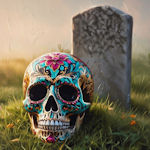
Puzzling Challenge
Several times a year, Detective Ray Kinsella visited Laurelwood Cemetery in Stroudsburg, Pennsylvania, to place fresh flowers on his mother's grave. Every Christmas, he spread a blanket of evergreen boughs and poinsettias over the bare ground. To celebrate her birthday in July, he chose roses. On Thanksgiving, he purchased mums. Mother's Day was special. He did not order flowers from the florist. Instead, he cut down an armful of blossoms from his wife's lilac bush. This was by no means an attempt to save money. He covered the grave with lilacs because it was Libby Kinsella's favorite flower.
On the second Sunday in May, the traditional day mothers are honored in the U.S., Ray and his wife carried the freshly cut lilacs from Ray's Subaru to Libby's final resting spot. While her husband knelt on the ground, arranging the flowers on the grave, Vivian scanned her surroundings. A splash of bright color on a nearby cemetery plot caught her attention. She leaned forward and squinted to get a better look.
"What on earth?" she mumbled.
"Did you say something?" Ray asked.
"There's a skull on that grave over there."
The detective stood up and followed his wife's gaze.
"It looks like a Halloween decoration," he noted.
"More like the Day of the Dead. No one paints skulls with bright colors for Halloween. Either way, it's disrespectful. I'm going to throw it away."
Vivian walked over to the grave, bent over and reached for the offending item.
"I think this is a real skull," she cried, dropping it on the ground.
After examining the partial human remains, her husband agreed with her.
"Who are you calling?" Vivian wondered when Ray took his cell phone out of his pocket.
"The station. I want a crime scene investigator here."
"This isn't a crime scene. There isn't even a whole body. Only a skull. Some kids probably dug it up from one of the graves, painted it and put it on display."
"Grave desecration and abuse of a corpse are both crimes. Maybe nowhere near as serious as homicide, but crimes nonetheless. Kids or not, I wouldn't want anyone digging up my mother's grave and chopping up her skeleton."
Before the crime scene technicians arrived, the detective took photos of the skull and the grave with his phone. He also took a close-up of the engraving on the headstone: Elizabeth Lyon, born 1911, died 1989.
"No flowers," his wife muttered.
"What's that?"
"No one put flowers on her grave. How sad! She's buried in a single plot, so she probably never got married. The poor thing had no husband or kids to visit her."
"Not necessarily. She might be in a single plot because she was divorced. As for kids, if she had any, they could have moved away. Or, more than likely, they simply stopped visiting the grave. After all, she's been gone for more than thirty-five years."
Their speculations about Elizabeth Lyon ended when the crime scene van arrived at the cemetery. Once the technicians cordoned off the area with yellow tape, warning people to stay away, the detective and his wife left the cemetery and headed toward the Shawnee Inn, where they would enjoy their annual Mother's Day brunch despite the macabre start of the holiday.
* * *
By Friday, Detective Kinsella received reports from both the lead crime scene technician and the medical examiner's office. As he had suspected, they determined the skull was taken from a human body. The unidentified person was female, approximately eighteen to thirty years of age. The medical examiner's report went on to detail how DNA could be extracted from the skull, but the detective was not interested in the science, only the result. Besides, he was only mildly curious about the identity of the person whose skull he found. After all, Ms. Lyon's death had not been classified as a homicide. Putting the reports aside, he returned to the case he had been working on: a jealous husband who fatally stabbed his wife's boyfriend.
It was not until the first week of June that Ray and his partner, Keenan Mars, handed the evidence of the stabbing of the murdered boyfriend over to the prosecutor. That same day, Dr. Adlai Langton, from the medical examiner's office, phoned Ray to inform him of a DNA match.
"The skull belonged to a woman named Elizabeth Lyon."
"That's impossible. You said the skull belonged to a young woman. Lyon was seventy-eight when she died."
"No. She was twenty-two. We traced her DNA to her mother, who lives in Phoenix. Praise be to those genealogical sites that share DNA information with the police! Anyway, Mrs. Lyon confirms that her twenty-three-year-old daughter, Elizabeth, went missing six months ago. I don't know where you got the idea that she was in her seventies."
Ray told him about the grave on which the skull was found.
"The same name, huh?" Adlai mused. "Funny coincidence."
"Maybe not," the detective responded, remembering his conversation with his wife about the lack of flowers on the grave. "The young Elizabeth Lyon might be related to the old woman buried in Laurelwood Cemetery. A granddaughter, maybe. The old woman's daughter might have moved from here to Phoenix."
"It's possible."
"You got a phone number for the mother? I'd like to talk to her."
"What was that all about?" Keenan inquired when his partner hung up the phone.
"Remember that skull Vivian and I found at the cemetery on Mother's Day? DNA says it belongs to a missing girl from Phoenix."
"Why do you want to talk to her mother? Is there any reason to suspect that she was killed here in Pennsylvania?"
"None that I'm aware of," Ray admitted. "I'm not certain she was murdered. She could have been sick or died in an accident."
"Then why get involved? Even if it was a homicide, it could have occurred in Phoenix or anywhere in between here and there," his partner pointed out.
"That's true. But how and why did the skull wind up on the grave of a woman with the same name? And why did someone paint it like one of those Day of the Dead skulls?"
Keenan threw his hands up in a gesture of mock surrender.
"Don't ask me why any of these nutjobs do what they do," he laughed. "I'm not Sigmund Freud. I'm an overworked, underpaid police detective. And I'm hungry. I'm going to go grab a sandwich at Wawa's. You want something?"
"Yeah. Bring me back an Italian hoagie."
Once his partner left to make a food run, Ray phoned Mrs. Lyon in Phoenix. Thankfully, the woman had already been informed of the gruesome discovery, sparing him the unpleasant task.
"Do you know how my daughter died, Detective?" she cried. "Did someone kill her?"
"We're not sure. With only a skull, we don't have much to go on."
That's an understatement, he thought.
He asked the grieving mother the usual questions in cases involving a missing person. He learned that Elizabeth was a recent college graduate, working her first job as a kindergarten teacher. She lived at home and had no boyfriend. It was only discovered she was missing when she failed to show up for work one morning. Her abandoned car was found in a Starbucks parking lot, so it was assumed she had been abducted when she stopped for coffee on her way to the school.
It seemed a clear case of abduction to Ray. Elizabeth Lyon was probably murdered in Phoenix by the person—most likely a man—who abducted her. But how had her skull wound up on a grave in Stroudsburg, Pennsylvania, roughly two thousand miles away?
* * *
Six weeks after the Kinsellas discovered the painted skull at Laurelwood Cemetery, FBI Special Agent Nelson Hartford showed up at the police station, asking to speak to Ray.
"What's this about?" the detective wondered.
"Elizabeth Lyon."
"What's the FBI's interest in her?"
"Since the victims were from multiple states, we're heading the task force."
"Victims? There's more than one? And what's this about a task force?"
After receiving the detective's assurance that the information would remain confidential, Agent Hartford shared the details surrounding the discovery of eight other painted skulls.
"We've identified all eight victims through DNA. All were young women. Although we don't know the actual causes of death, we're treating them as homicides. Like the skull you found, the other victims' skulls were painted and placed on the graves of people with the same name as theirs. These women went missing from nine different states, and they were later found in nine different ones. So, we're talking about eighteen states altogether. That's assuming the women were killed in either the state where they were abducted or where their skulls were found. For all we know, though, they could have been killed anywhere."
"We're dealing with a serial killer, then? One who obviously has the means to travel around the country."
"It would appear so."
"And you want me to be part of your task force?"
"Not exactly. But we do want you to keep an eye out for us and get back to us if you discover anything. Your skull, by the way, was the most recent one found."
Agent Hartford reached into his briefcase and pulled out a file folder containing roughly a hundred pages.
"This is what we have on the victims so far," he stated.
"There's not much here," Ray complained.
"I'm afraid it's all we've got. We don't know where or how these women were killed, so we have no murder scenes and, therefore, very little forensic evidence. All we have are painted skulls and highly unusual dump sites."
"Unusual? That doesn't begin to describe this case."
"What puzzles me," the agent claimed, "is what came first, the chicken or the egg?"
"I don't follow you."
"Did the killer target these women because they had the same name as those on the graves? Or, did he kill the women and then search the internet for graves that bore the same name as his victims? If we know the answer, we might better understand the killer's motive."
Ray shook his head and confessed, "I wouldn't be able to understand this psycho's motive even if I had it spelled out for me."
* * *
Detective Kinsella went home from work that night to find Vivian sitting in his recliner, feet up, with a cup of coffee on the end table. In her hands were her two best friends: a puzzle book and a sharpened pencil.
"Dinner will be done in about ten minutes," she announced and wrote something down in her book.
"Crossword or anagrams?" her husband asked.
"Neither. These are cryptograms."
"You and your puzzles," he laughed, eying the stack of roughly two dozen puzzle books and magazines on the coffee table.
"I like to think it keeps my mind active. You've got your cases to solve; I've got my puzzles."
Ray believed his wife's fascination with word games was a waste of time, but he was sympathetic to her thirst for mental stimulation. For twenty years, she worked in a high school cafeteria. Making sandwiches and microwaving hot lunches for ungrateful teenagers did not challenge her intellect. Unlike her husband, she had never attended college. Due to this lack of advanced education, her job choices were limited and often made her feel inferior to him, but to her credit, she never complained.
When Ray went upstairs to change into more comfortable clothes, Vivian put down her book, went to the kitchen and tossed a salad to eat with dinner. She poured two glasses of Turkey Hill iced tea and removed the meatloaf and baked potatoes from the oven.
"Smells good," her husband declared, taking his seat at the dining room table.
Rather than begin the meal with bowing her head and saying grace as her grandparents had, Vivian asked her husband the usual question: "How was your day?"
Normally, he could sum up his entire workday in one or two words, or sometimes a few simple sentences. Not so this time.
"An FBI agent came to see me."
Long after the meatloaf, baked potatoes and salad were finished, the detective was still going on about his visit from the feds. Over donuts and coffee, he told her about the eight other women who had suffered the same fate as Elizabeth Lyon had.
"Amazing!" she exclaimed. "Nine women from nine different states. Does the FBI have any suspects?"
"No. But the killer is either wealthy or he's got a job that requires him to travel around the country."
After straightening up the kitchen and putting away the clean dishes, Vivian joined her husband in the living room. Surprisingly, the television was not on. Instead, Ray was reading the pages Agent Hartford had given him.
"Not watching anything?"
"Nah. I wanted to read some of these reports."
"It's not like you to bring your work home."
"This isn't like any case I've ever had before."
"Can I see?" his wife asked.
"Sure."
Vivian loved murder mysteries and true crime books only slightly less than she did word puzzles. Every night, when she went to bed, she picked up her Kindle and read for an hour or two. She shared this passion with a group of online friends, all wives of police detectives like herself. These women met in Las Vegas when their husbands were attending a sensitivity training seminar.
After reading only two chapters of a cozy mystery set in a quaint village in the Cotswolds, she got up and went to the den where she kept her laptop. She sent a message to the group, informing them of the day's events. She ended the post with her username, Marple, by quoting from Sir Arthur Conan Doyle's famous detective: "The game's afoot."
* * *
The next evening, Ray was back to watching television after dinner.
"Losing interest in that case?" Vivian teased.
"There's not a hell of a lot I can do. I've got nothing to go on but a skull. For all I know, she was murdered in Phoenix, in which case, the homicide is out of my jurisdiction."
"Mind if I look at that file again?"
"Why not? It's on the desk."
Vivian retrieved the folder from the den and brought it into the living room. While her husband streamed a limited series on Netflix, she copied key facts from the file onto a legal pad.
"Find anything interesting?" Ray wondered when the credits rolled after the second episode of the series ended.
"I'm not sure. But when I read the victims' names, I found a pattern. Look," she instructed, rewriting the women's names in a different order. "Virginia Cowan, Ursula Hubert, Wilma Ashburn, Olga Langstrom, Elizabeth Lyon ...."
"That's the one we found," her husband interrupted.
"Sylvia Eames, Inga Nielson, Roseanne Groves and Yolanda Estaban."
"I'm sorry, I don't see any pattern."
"Look at the first letters of the surnames. C-H-A-L-L-E-N-G-E. That spells the word challenge. It appears as though the killer is challenging someone to solve the murders."
"You can't be serious! This isn't one of your word puzzles," he laughed. "This is nothing but a coincidence."
"You know best, dear," his wife conceded. "You're the detective, not me."
The third episode of the limited series began, and Ray turned his attention back to the television. Meanwhile, Vivian, referring to the FBI's file, continued writing notes down in her pad.
* * *
At one o'clock in the afternoon, Vivian Kinsella logged onto the group chat. It was a time convenient for all nine women, who were scattered in different parts of the country and different time zones. Marple, the cafeteria worker from Pennsylvania, began the conversation.
MARPLE: Any news about the murders from your husbands?
HOLMES: Mine has been tight-lipped about them. He hasn't even mentioned his visit from the FBI.
POIROT: Mine either. But then most of the city's detectives don't like the feds getting involved.
HAMMER: As I've said before, my husband never discusses his cases with me. He thinks I might get upset by the gruesome details.
MARLOWE: Sounds familiar. My "macho man" treats me like a delicate flower, too. He won't let me lift a finger around the house.
SPADE: Don't complain. At least he doesn't treat you like an imbecile. Mine thinks I don't have the brains to understand basic police procedures.
DUPIN: Given all the true-crime books and mystery novels we read, we probably know as much as, if not more than, our detective husbands.
WIMSEY: Don't tell them that!
BOSCH: My husband insists that books aren't indicative of actual police work.
POIROT: Even those written by Joseph Wambaugh? He must know what he's talking about. He was with the LAPD for fourteen years.
BOSCH: It doesn't matter. He insists Wambaugh dramatizes too much.
MARPLE: Have any of you mentioned the surname anagram theory yet?
WIMSEY: I did. My husband thinks it's a bunch of bullshit—pardon my French.
SPADE: Mine laughed in my face.
HAMMER: I'll tell mine about it tonight after dinner. Last night, he went bowling with the guys.
It was the consensus of the group that not one of the husbands would give credence to the theory, especially since it was presented by a mere wife, not a police detective.
* * *
With school over for the summer, Vivian had a lot of free time on her hands. Until classes resumed at the end of August, she would have to find ways of passing the time. Contact with her online group was limited since nearly all of the other members had year-round, full-time jobs, except for Spade, who worked at home and thus made her own hours, and Dupin, who worked part-time as an assistant librarian.
"How much housework can one woman do?" she groaned after waxing her hardwood floors, shampooing her bedroom carpet and washing the windows inside and out.
She went through two crossword books, one acrostic and three word searches before the first of July. When she was not solving word puzzles, she would look through the FBI file on what was being referred to as the Painted Skull Killings, paying close attention to the notes she had already made on her legal pad.
When Ray came home from work on the evening of July 3, eagerly looking forward to a day off on the Fourth, he found her in the recliner, furiously writing with a pencil.
"What's for dinner?" he asked.
"I ordered pizza tonight. It ought to be here any minute."
"We got any beer?"
"Yeah. I bought a case for the barbecue, but you can have one with dinner."
The pizza had not yet arrived when Ray came back downstairs, dressed in more comfortable clothes.
"What's that you're doing? You making your grocery list or did you run out of puzzle books?"
"I've been looking at the victims of the Painted Skull Killer, and I've noticed another pattern."
Ray rolled his eyes, an expression that indicated his disbelief in and disdain for her idea.
"Funny that you see these patterns but the FBI doesn't."
"They're too busy looking for physical evidence," Vivian pointed out.
"That's not true. I hear the Behavioral Analysis Unit developed a profile of the killer."
"Oh? Did Special Agent Hartford say anything about it to you?"
"Just the usual psychobabble drivel. Unsub is white male, loner, suffered abuse as a child, strict religious background."
"Hmmm. Interesting."
"Nelson Hartford didn't mention anything about the killer having a love of anagrams."
"Will you at least take a look at my latest theory before you write it off as utter nonsense?"
"All right," Ray agreed, only willing to listen to his wife because the pizza had yet to be delivered.
"Look at this list," Vivian said, pointing to a list on her legal pad. "They are the locations where the girls were last seen."
"Yeah. Florida, Texas, Colorado and so on .... So? We already know the victims were taken from different stations. Hence, the FBI's involvement."
"Never mind the states, look at the names of the cities."
"Kissimmee, Irving, Denver .... I don't see any pattern."
"Nyack, Alexandria, Plymouth, Phoenix, Edison and Durham. Look at the first letter of each city. K-I-D-N-A-P-P-E-D."
"You're reaching," Ray declared dismissively.
"Am I?"
"Pizza's here," he declared, relieved for an excuse to end the conversation.
* * *
With her husband riveted by a Yankees-Red Sox game in the family room, Vivian was upstairs in the den, discussing the latest developments in the painted skull case with her online group.
MARPLE: I presented my latest theory.
SPADE: What did he say?
MARPLE: He doesn't buy it.
BOSCH: At least he gave you the courtesy of listening to it. That's more than my husband did.
MARPLE: He was a captive audience. He was waiting for the pizza delivery guy to show up.
DUPIN: Did you know the BAU has a profile?
HAMMER: No! Really? You know my husband never discusses his work with me.
WIMSEY: What does it suggest?
DUPIN: I don't know. I don't think my husband read it.
POIROT: I know mine didn't. He doesn't trust the feds and doesn't believe profilers know what they're talking about.
MARPLE: My husband read it. He told me it contained the usual—as he put it—"psychobabble drivel."
MARLOWE: What exactly did it say?
MARPLE: He didn't relate the contents verbatim. He said only that the killer was most likely a white male who suffered abuse as a child and had a strict religious background.
DUPIN: Sounds like the majority of the serial killers I've read about.
SPADE: So, police departments around the country will be looking at the usual suspects and questioning the men on the various sexual offenders lists.
WIMSEY: And not a single detective will pay attention to the anagram theory.
* * *
Vivian Kinsella's smile stretched from ear to ear when her husband told her about the meeting to be held at FBI headquarters in Washington.
"Oh, good!" she exclaimed. "I'd better get tickets to see Ford's Theatre in advance. When we went to Washington two years ago, they were sold out."
"Wait a minute. You're not going with me," Ray said. "The meeting is only for detectives connected to the Painted Skull Killings."
"I don't expect to be invited to the meeting. I'll sightsee while you attend."
"This isn't an educational seminar like the one in Vegas. No wives are going. The FBI made the arrangements. I'll be sharing a room with a detective from Ohio."
Disappointed that she would not be spending a week at the nation's capital, she poured herself a cup of coffee and sat down in the recliner with her legal pad. Meanwhile, her husband went to the family room to watch another Yankees-Red Sox game. Three hours later, he joined his wife in the living room. He frowned when he saw her scribbling away with a pencil.
"I found another pattern," she announced.
"Not again," he grumbled. "What is it now? The last letters of their surnames spell out another word?"
"Not their names."
"What then? The months they were born? Their astrological signs?"
"There's no need for sarcasm."
"I'm sorry, but these theories of yours are ridiculous!"
"These aren't mere coincidences. Take a look and see."
"No."
"Why not?"
"Serial killers don't plan their murders based on anagrams. Do you think Ted Bundy chose his victims based on words he could form from the first letters of his victims' names? Or did Dahmer plan to have the initials of his victims unscramble to form an item on his cannibal menu? Maybe Gacy wanted his victims' names to spell out Pogo the Clown."
"I concede that most serial killers choose their victims randomly. But what about Zodiac? He sent cryptic messages to the newspaper, challenging people to decipher them."
"We're talking about nine women abducted from nine different states, murdered god only knows where or how. Their skulls were deposited in nine different states, on graves that share their names. These crimes alone took a good deal of planning. Now you expected me to believe that the victims and the locations where they were abducted were chosen specifically because their names spell out clues for the police? I don't buy it."
"You're forgetting the names of the places where the skulls were discovered. They also spell out a clue."
"Is that what you're doing now? Trying to form a word with the names of those towns and cities?"
"Yes. And I have. Detroit, Irvine, Stroudsburg, Chicago, Ogunquit, Vicksburg, Eau Claire, Reno and Youngstown. D-I-S-C-O-V-E-R-Y. Tell me that's a third coincidence."
"I give up," Ray sighed and went upstairs to bed.
* * *
After checking in with her online group, Vivian ascertained that all the women's husbands would attend the meeting in Washington. Furthermore, not a single wife was allowed to go along.
POIROT: We should have expected as much. No one cares about our opinions.
DUPIN: Why should they? We're not policemen. My husband has made that point clear to me over the years.
WIMSEY: Let's face it. Even dogs in the Canine Unit get more respect than we do when it comes to solving crimes.
HAMMER: I don't understand these so-called detectives. Three groups of names spell out three clues pertinent to the case, yet all of them insist it's nothing more than coincidence. Do they need a house to fall on them?
HOLMES: Apparently so.
SPADE: It's not as if our husbands aren't good at their jobs. It's only that this case is so bizarre. They can't fathom anyone being so devious as to dream up such a complex series of murders.
MARLOWE: Devious? I prefer the word imaginative.
BOSCH: Our husbands leave for Washington in four days. When do we reveal the final pattern?
MARPLE: The evening they arrive. According to the itinerary the FBI sent my husband, there's to be a dinner for all attendees. I've arranged for a copy of the list to be hand-delivered to all nine of our husbands during happy hour.
DUPIN: What I wouldn't give to see their faces when they read it!
POIROT: I don't think any of them will be particularly happy.
* * *
Ray Kinsella was surprised to see that eight of the other seventeen detectives involved in the Painted Skull Killings were men he met at the sensitivity training seminar he had attended in Las Vegas. There were more than 10,000 police detectives in the U.S., 280 of whom attended that seminar. And yet, half the investigators at the Washington meeting were among them. However, as was the case with the three anagram clues Vivian had shown him, Ray attributed that fact to mere coincidence.
When the nine law enforcement officers entered the lounge, they gathered at the bar.
"What can I get you gentlemen?" the female bartender inquired.
"I'm not on duty, so I'll have Scotch on the rocks," answered Detective Avery Spector from Ohio, who was married to the woman known as Holmes in Vivian's online group.
Ray preferred a martini, as did Tucker Strathmore and Eustace Horgan, the husbands of Dupin and Poirot. As the men discussed sports—agreeing by unspoken mutual consent not to talk about the murders outside of the meeting—they were unaware that their wives kept in touch via the internet.
Detective Ike Gandle from Maine (married to Bosch), a Red Sox fan, got into a friendly disagreement with Ray, a die-hard Yankee fan. Detroit native Tyrell Franks (married to Hammer) expressed his fondness for the Tigers while Merle Duggin, who lived in Chicago and was married to Wimsey, rooted for the Cubs. Nico Palladino from Irvine, California, the husband of Spade, was about to mention the Dodgers when a uniformed courier entered the room.
After confirming the identity of the nine men, he gave each of them a sealed manila envelope.
"What's this?" Brody McMasters from Wisconsin (husband of Marlowe) asked rhetorically.
"I wonder who sent this," Eustace said, noticing there was no return address on the envelope.
"Let's open them up and see," Avery suggested.
"What the hell!" Nico exclaimed when he saw a list of the victims' names with the first letter of each woman's first name circled.
"This reminds me of the so-called clues my wife found," Ray declared.
"Your wife?" Tucker echoed. "My wife showed me the same clues, claiming the letters were anagrams that could be rearranged to spell out the word challenge."
"My wife did the same," Merle said. "She also showed me two other anagrams. The second used the first letter of the towns where the women were abducted and spelled out kidnapped."
"And the third spelled out discovery," Ike added.
It was soon apparent that all four wives had shown the anagrams to their husbands, none of whom paid much attention to them.
Ray was the first to notice the fourth, and last, anagram. Since it spelled out two words instead of one, it was not immediately apparent.
"I see a pattern here: Yolanda, Olga, Ursula and Roseanne. Y-O-U-R. Wilma, Inga, Virginia, Elizabeth and Sylvia. W-I-V-E-S. This was sent to us by our wives."
Not even the most skeptical of the detectives ignored the significance of the clue.
"Our wives met at the seminar in Las Vegas," Avery recalled.
"And while we were learning how to be more sensitive, they must have been planning these murders," Ray theorized.
"My wife wouldn't harm a fly," Nico argued. "Besides, when we were in Vegas, she went shopping, saw a Cirque du Soleil show and played the slots."
"And my wife spent her time at the pool and the spa. I know because I had to pay the bill for her facial, manicure and massage," Ike insisted.
"Besides, how could our wives have logistically committed these homicides?" Tucker asked. "As unlikely as it is, while my wife might conceivably have placed a painted skull on a grave in Reno, Nevada, she could not have abducted Roseanne Groves from the Edison Towne Square mall in New Jersey. She's never been to New Jersey."
"We live in Michigan," Tyrell declared. "My wife has never been south of Ohio, much less Florida."
Detective Duggin was the only one of the nine men whose wife was a frequent traveler. The woman known to her friends as Wimsey, who took her username from the character Lord Peter Wimsey created by Dorothy L. Sayers, was a motivational speaker whose job took her to cities and towns across the country. When Merle looked at the locations of the abductions, his face lost its normal rosy color.
"M-my w-wife ...," he stammered. "S-she went to Phoenix in November."
"That's when and where Elizabeth Lyn went missing," Ray said.
"During the past eight months, she also traveled to Durham, Plymouth, Irving, Denver, Nyack ...."
"You're saying your wife could have abducted these nine women?" Nico asked with astonishment.
"If she took them, she must have ...," Tyrell began but stopped speaking when he realized he was about to accuse a fellow detective's wife of multiple murders.
Stunned by their discovery, the nine men left the bar and went to Ike Gandle's room, where they studied the case files the detective from Maine had brought with him.
"I always thought there was something familiar about these painted skulls," Brody observed, tears forming in his eyes. "My wife is an artist. I never realized how much the paintings looked like her work."
For the remainder of the night, the detectives examined the murders from every angle. Regrettably, they came to the painful conclusion that one of their wives (Octavia Duggin, aka Wimsey) had abducted all nine victims. Somehow, she convinced each woman to visit the cities and towns where the other eight wives lived. Once there, they were killed. Their bodies were buried in unmarked graves, and their skulls were shipped to Eugenie McMasters, username Marlowe, to be painted and returned to the women who killed them. These women then deposited the painted skulls on the preselected graves.
"Technically, we're not married to serial killers since each of our wives killed only one person," Ike said, foolishly believing that the fact would give his fellow lawmen comfort.
"Which one of them came up with this diabolical plan?" Avery wondered.
"Does it matter?" Ray replied. "They all took part in it."
"The question is, what do we do now? Do we turn our wives in to the FBI?" Tucker inquired.
"How can we? We're talking about the women we love, the mothers of our children," Eustace answered.
"Even if we did turn them in, I don't imagine Special Agent Hartford will believe us," Tyrell opined.
"I find it hard to believe myself!" Ray exclaimed. "Vivian, a murderer!"
"One thing is clear," Nico concluded, eager to go to his own room to get some much-needed sleep. "We all underestimated our wives."
"That's a mistake I won't make again," Tyrell vowed.
The other eight detectives silently agreed with him.
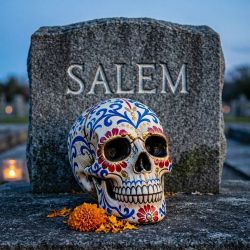
Don't be frightened, Salem. You're not in any danger. That's a human skull, not a cat skull.


